
Have you ever wondered why you seem to have no luck in love? Perhaps it’s not a matter of luck… perhaps it’s an unconscious, inherited pattern. In this article, we explore the impact of the father figure on our childhood psyche and how it can affect our adult life and the partners we form relationships with.
Emotional DNA: The template we didn’t choose.
From a psychological perspective, human beings are born with needs that go beyond the purely biological (food and shelter). During the stages of our cognitive development, especially in childhood and pre-adolescence, our environment and lived experiences play a fundamental role in shaping our adult lives.
For better or for worse, this stage establishes the “template to follow.” Our psyche observes and assigns roles. Here, we focus on the dominant male figure (father, stepfather, grandfather, uncle, etc.). The psyche takes note of what it means “to be a man,” “to be a father,” and what to expect from these figures later in life.
- For girls: This figure determines the “default template” (using “default” because it can change) of what they look for, accept, and allow in their future partners.
- For boys: This figure determines the kind of man they themselves can become or what they absolutely decide not to be.
The father wound
When, during childhood, the father figure, instead of being a healthy role model (offering protection and security), is instead a figure who instills fear, terror, or any harmful behavior, a deep emotional wound is created. This wound directly affects identity, self-esteem, the ability to set boundaries, the relationship with authority, and the sense of security.
- In women, this manifests as an (unconscious) search for external validation or for unattainable partners who trigger the same emotional responses as the father figure used to.
- In men, it often manifests as insecurity about their own masculinity and difficulty achieving their goals.
The fundamental premise is that the relationship with the father or male authority figure directly influences how the person relates to himself (and therefore to others), to power, and to success.
The mirror of my story: An invitation to look at yours.
The first few times I heard about the concept of the father wound, I thought, “Thank goodness I don’t suffer from that.” Because from a very young age, it was made clear to me that my father was a man who lived far away and that I only saw him for a couple of weeks a year. I didn’t feel like I was missing a father because I knew he existed somewhere. And I didn’t miss his presence because he simply was never there; his absence was the most normal thing in my life.
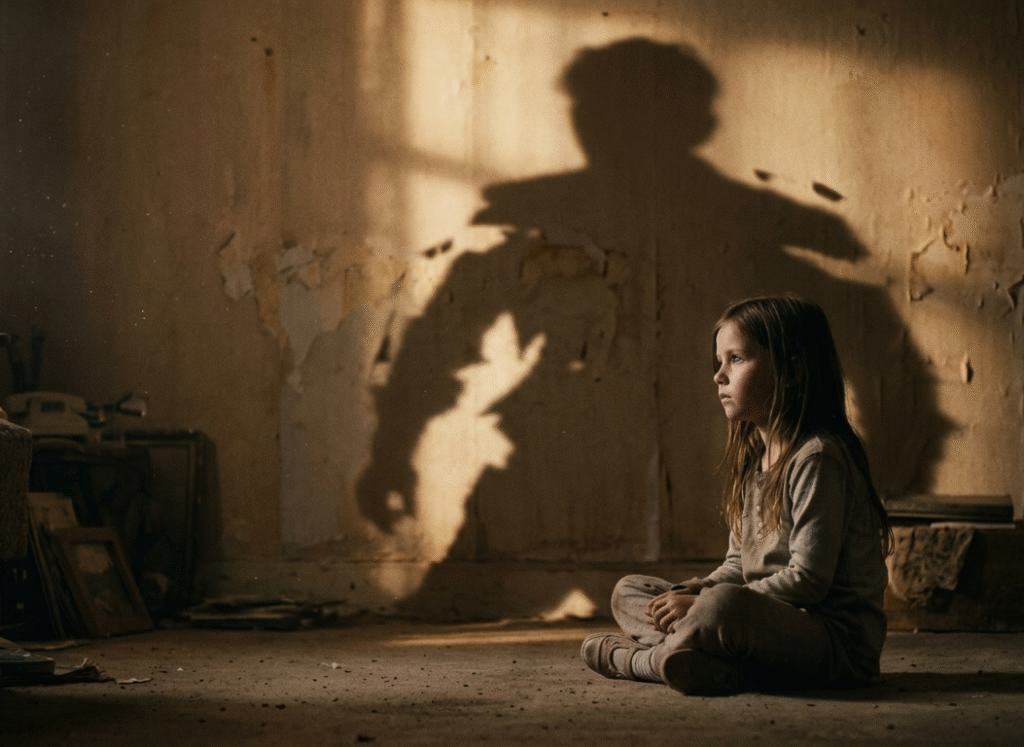
However, during my childhood, there was a male authority figure: my stepfather. A man I don’t consider a bad person, but who had anger issues. Someone who was sometimes fine and then suddenly let out a yell that set all your nerves on edge. I would panic. He never physically abused me, but I still remember the yelling.
The normalization of the noise: Why I didn’t see the red flags.
Having grown up exposed to emotional outbursts increased my tolerance level. When I observed these outbursts in my partners, I didn’t recognize them as something negative. I was used to it.
Until I realized that continuing to expose myself to these outbursts triggered my nervous system and activated all my stress responses. My physical and mental health were at risk.
Recognizing the pattern was the first step to breaking out of it.
The myth of “What Should Be”: When presence hurts more than absence.
When I was twelve, I received the news that the man I thought was my father wasn’t, but another man I’d never heard of until then (my real biological father). And that I would soon meet him and we would go live with him.
This news was, in a way, a pleasant surprise, because I thought: “Well, at least now I’ll have a present father who loves me and treats me well.”
I couldn’t have been more wrong. I found myself with a kind of tormentor, whose greatest hobby seemed to be finding reasons to punish me, scolding me for fabricated gossip, and controlling my every move. That time living with him was the worst of my life, and on the day of my eighteenth birthday, I left home.
However, I didn’t cut him out of my life completely. We maintained a sporadic, “political” contact.
In short: my wound began with a stepfather who had explosive outbursts (I normalized fear and verbal abuse) and was reinforced by a controlling biological father (I learned that authority can be a form of confinement). Both figures left their mark.
The limit as a shield: You don’t reap what you don’t sow.
As I was approaching thirty, this man (my biological father) started sending me emojis every day and trying to establish a relationship with me that was never there. It triggered a deep sense of unease in me. Since when? I found it impossible to go along with it and asked him to please stop. I could tolerate occasional contact, but this whole thing of pretending we had a good relationship overnight? No way.
I don’t wish him ill and I hope he finds his own peace, but the contact with me… what’s the point now?
Setting a boundary is simply the adult decision to protect the peace I worked so hard to build.
Inheriting consciousness: The end of the cycle.
If the father is the template of protection and identity, bringing someone into the world who cannot fulfill that role (or who will do so through violence) is sabotaging a child’s emotional development before it even begins.
Therefore, this journey leads me to emphasize the importance of carefully considering with whom to have children, or deciding not to have children at all.
- Presence doesn’t guarantee health; sometimes absence is the best gift.
- Bringing children into the world unconsciously is bequeathing them a battle with their existence that they didn’t ask for.
- The template isn’t DNA, it’s the daily dynamics the child observes in their environment.
The “father wound” heals when you stop trying to repair the bond with someone who never wanted to build it.
Now it’s your turn. Look at your childhood, find the pattern. Look at your adult life, recognize the echo. The wound doesn’t define who you are, but understanding it can set you free.
If this analysis of the father’s wound resonated with you, you might want to explore the other side of this story in my reflection on [The Mother’s Wound].