
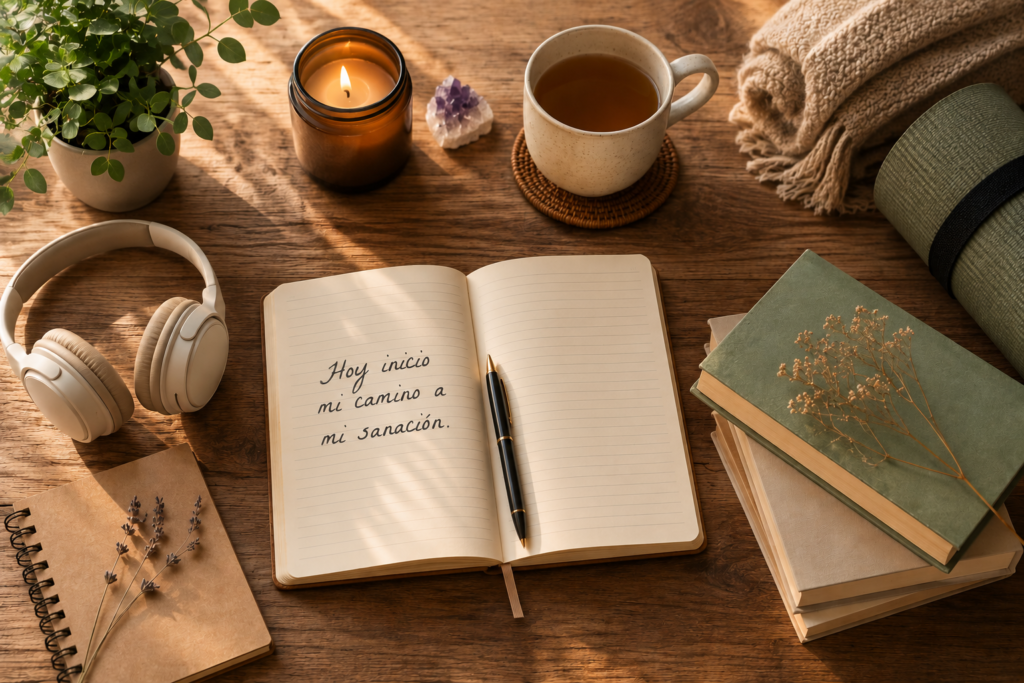
If you’ve made it this far, you’ve probably already taken one of the most important steps in any healing process: recognizing that a wound exists.
Understanding our pain, identifying the patterns that sustain it, and becoming aware of how it impacts our lives is the beginning of the journey. However, understanding alone isn’t always enough. Once we see the wound, a natural question arises:
So what do I do with it now?
Healing doesn’t happen overnight, and there isn’t a single tool that works for everyone. Each process is unique, and what is transformative for one person may not be what another person needs at this moment in their life.
Fortunately, there are practices that can help us develop greater awareness, regulate our nervous system, process accumulated emotions, and create the necessary inner space for healing to occur.
In this article, I share a list of practical tools and resources that can accompany you in the process of learning to relate to yourself, your emotions, and your personal history in a healthier way.
Read slowly, listen to your intuition, and choose the tool that resonates most with you at this moment in your life.
Your path of personal evolution has already begun. Let’s discover how to nurture it. 👇
Foster Awareness and Introspection
- Ask yourself questions, question your life, evaluate yourself. The foundation of healing is self-observation.
- Meditation: For me, meditation is one of the most powerful healing tools. Through it, we foster self-knowledge and self-observation, fundamental when it comes to recognizing harmful patterns in our lives.
Not to mention its many other benefits, such as regulating our nervous system and promoting homeostasis (the body’s harmony). - Therapeutic Writing: The simple act of writing down what you feel without judgment helps clear the chaos from your mind and allow you to see it objectively. You can practice free writing or use the Unsent Letter technique to release repressed emotions directed at a person or situation from the past.
- Record yourself expressing yourself: If writing is difficult for you, you can try recording yourself on video (or just your voice) talking to yourself and expressing how you feel. It’s just as liberating as writing. Over time, you can review your recordings and see how you’ve progressed.
Somatic Healing (Body-Mind)
- Somatic Movement Therapies: This approach is vital to releasing trauma and emotions that have become “frozen” in our bodies (a concept you can explore in the book The Body Keeps the Score by Dr. Bessel van der Kolk).
- Through practices such as Somatic Yoga, Dance Therapy, Ecstatic Dance, Neurogenic Tremor Release (TRE), and Somatic Experiencing (SE), we move the body consciously. This fosters a connection with the physical body, mind, and emotions, allowing tension and pent-up emotions to be released.
- Through practices such as Somatic Yoga, Dance Therapy, Ecstatic Dance, Neurogenic Tremor Release (TRE), and Somatic Experiencing (SE), we move the body consciously. This fosters a connection with the physical body, mind, and emotions, allowing tension and pent-up emotions to be released.
- Music: Music has the ability to access emotional layers that we sometimes can’t reach with words. It helps us feel, release, and also regulate our nervous system. We don’t always need the same type of music: there are times to delve into what hurts, others to integrate and let go, and others simply to rest from the chaos and return to calm.
I’m sharing some playlists that have accompanied my own healing processes. Use them as support, listening mindfully and allowing yourself to feel whatever arises, without forcing anything and respecting your own pace.
Listen to the one that resonates with you right now; there’s no right order.
🎧 Playlist 1 — To get through intense emotions
Music for moments when you need to allow yourself to feel without filters. It accompanies processes of introspection, grief, and emotional release. It’s not lighthearted, but it can be profoundly healing if you give yourself the space to listen with presence.
🎧 Playlist 2 — Healing – Music for the Soul
Music that invites you to integrate your experiences, let go of what no longer serves you, and reconnect with the beauty and loving energy of life. Ideal for when your heart needs gentleness, openness, and emotional rest.
🎧 Playlist 3 — Return to peace
Music to regulate the nervous system, quiet the mind, and escape chaos. It accompanies moments of rest, meditation, or when you simply need to find your center again.
External Support
- Formal Psychological Therapy: It’s important to recognize that for deep wounds or complex traumas, professional guidance is an act of strength. A therapist can support you with guided methods such as EMDR or Internal Family Systems (IFS) Therapy. Seeking external help is part of the healing process.
- Recommended Books: Reading is a great complement to understanding and delving deeper into the process.
- This Pain Is Not Mine, by Mark Wolynn
- The Body Keeps the Score, by Dr. Bessel van der Kolk
- You Are the One You’ve Been Waiting For, by Richard Schwartz
- A Course in Miracles. (My favorite, and the one that has been most significant in my life)
✨ Conclusion: Healing is Built with Practice
The path to emotional healing is deeply personal and not always linear. There will be days when writing or meditating flows easily, and others when you just need to press play and let your body release what your mind can’t yet process. That’s perfectly fine.
Healing is about actively choosing, every single day, to stop picking at the wound and allow it to finally heal. Remember that every time you choose to observe instead of react, to write instead of repress, or to allow your body to move to release tension, you’re taking a giant step toward the wholeness, harmony, and inner peace you deserve.
Personal evolution is our primary purpose, and healing is simply the map that guides us back to ourselves.
👉 Now it’s your turn: Don’t try to do everything at once. Of all the tools we explored today (meditation, writing, somatic movement, or music)… which one will you choose to begin or continue your journey this week?
Leave your answer in the comments, save the playlists for when you need them, and if this article gave you some insight, share it with someone you know who’s also on their own healing journey. See you below!